Some supporting characters have the power of stealing main characters’ thunder in movies and TV shows – for instance, Amy Poehler is super funny but to me Tom Haverford is the highlight of Parks and Recreation.
I finished the first season of the excellent The Killing and was amazed by Mireille Enos’ strong performance, but Joel Kinnaman was the real surprise here: his Stephen Holder is a delight to watch, adding a much needed – and intelligently made – comic relief to a very dark show. He has the best lines and deliver them perfectly, making me laugh like crazy in several scenes – one of my favorites is the one in which Linden tells him that he can’t eat pork rinds if he’s a vegetarian and he tells her that “pork rinds are junk food, don’t count” (here at 1:10 if you want to enjoy it). :D
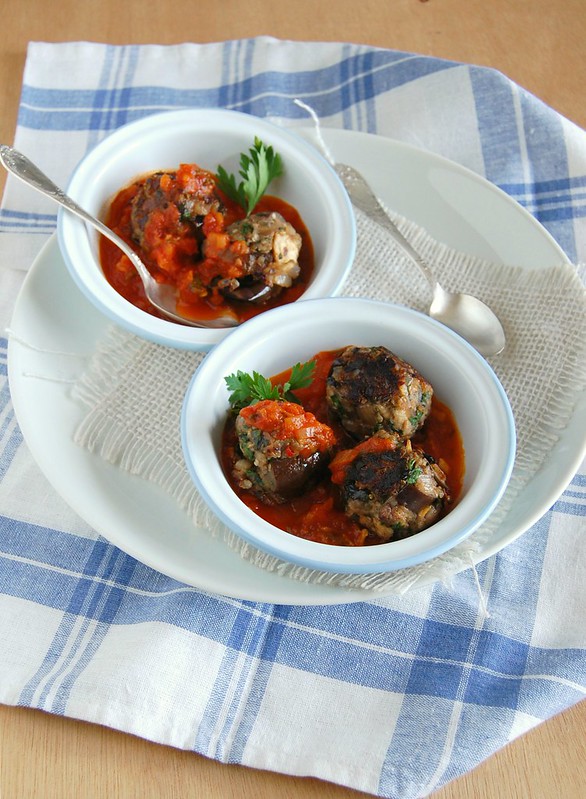
These “meatballs”, made out of eggplant with no meat whatsoever, are delicious – I served them with pasta and it was a hit. They’re very soft and it took me a while to shape the mixture into balls so I thought of adding an egg to it, but since my husband kept snacking on the mixture while I tried to rolled it I skipped the egg and added more breadcrumbs instead – it worked like a charm and I just had to be careful while frying them to keep them from falling apart.
I believe these eggplant “meatballs” will be a hit at your house as they were in mine - either if you’re a true vegetarian or a Holder-kind-of-vegetarian. :D
Eggplant “meatballs”
slightly adapted from A Girl Called Jack: 100 Delicious Budget Recipes
1 eggplant
1 onion, finely diced
1 far garlic clove, finely chopped
1 red chilli, finely chopped
3 large black olives, finely chopped
2 tablespoons canola oil
finely grated zest and juice of 1 small
about ¼ cup breadcrumbs
2 tablespoons grated parmesan
small handful parsley leaves, chopped
small handful basil leaves, chopped
salt and freshly ground black pepper
tomato sauce, to serve
Cut the stems off the ends of the eggplants and halve lengthways. Dice the flesh into chunks and pop into a medium nonstick saucepan or frying pan. Add the onion, garlic, chilli and oliver, add 1 tablespoon of the oil and cook on a medium heat for about 10 minutes to brown and soften.
Add the lemon zest and juice, mix to combine, then remove from the heat and transfer to a large bowl. Cool slightly. Add the breadcrumbs, parmesan and herbs. Season with salt and pepper. Shape the mixture into tablespoon-sized balls with your hands. Wipe the nonstick frying pan clean with a kitchen towel and pour in remaining 1 tablespoon. Heat over medium heat, then carefully fry the eggplant balls in batches until browned all over. Remove with a slotted spoon and serve with the tomato sauce.
Makes about 12
Friday, March 14, 2014
Eggplant “meatballs” and Stephen Holder
Friday, January 10, 2014
Baked sausages with tomatoes, peppers and onions, a movie, many tears and a wish
The subject of traveling in time has produced a handful of movies, some interesting, some hideous. Last night I watched another movie about it, by far the most beautiful one: a movie that made me cry like a baby (there were so many tears I had to dry them on my cardigan sleeve), that made me think of many things in life and that made me wish I could, too, go back in time.
I kept thinking of how incredible it would be to go back to my past and started imagining my mother and I in our kitchen – with the table where I used to do my homework while she did the dishes after lunch – and pictured us both cooking: I was chopping some onions, she was grilling a steak. And the funny thing is that in my head I wasn’t a kid: I was a 35-year-old adult, as I am today, standing next to her, who looked like she did when I was five. And another funny thing is that I don’t know why I thought of her grilling a steak since I hated it as a child – I usually ate my steak stone cold after seating on the table for hours, forbidden to leave as long as there was food on my plate. :)
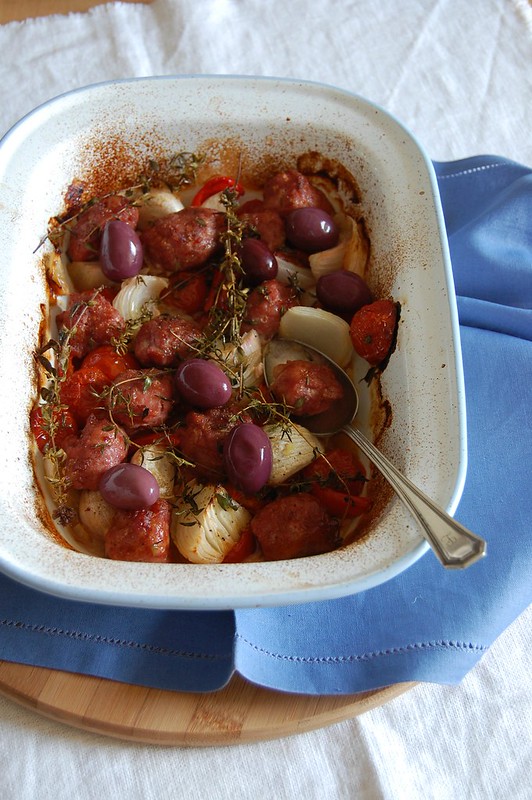
Because Richard Curtis made me think of my mom a lot more than I already do every day, I decided to share this delicious recipe with you today: as a good German descendant, she loved pork (and cabbage – boy, she just loved the stuff) and I am sure she would go crazy for sausages cooked this way – the meat portions get golden and crispy on the outside, while tender and juicy within, and the thyme adds a wonderful touch.
Baked sausages with tomatoes, peppers and onions
from Bill Granger’s TV show “Bill’s Notting Hill Kitchen”
2 onions, peeled, halved, and each half cut into 4 pieces
1 large red pepper, seeds removed, cut into chunks
6 cloves of garlic, unpeeled
200g cherry tomatoes
extra virgin olive oil, for drizzling
salt and freshly ground black pepper
4 sausages
5-6 fresh thyme sprigs
handful black olives
Preheat the oven to 200°C/400°F. Place the onions, pepper, garlic and tomatoes in a medium roasting pan or ovenproof dish, drizzle with a little olive oil and season with salt and pepper. Mix to coat. Remove the sausage from their skins in portions (about the size of a meatball) and place over the vegetables. Scatter with the thyme sprigs, drizzle with a little more oil and bake for about 1 hour, turning the sausage halfway through cooking time so the pieces are golden all over. Remove from the oven, scatter with the black olives and serve.
Serves 2 generously
Sunday, March 3, 2013
Chicken, chorizo and lemon bake
When I was little, roast chicken was the Sunday lunch staple: the side dishes would change sometimes - potatoes, pasta, rice, salad - but the chicken was the king of the most important Sunday meal. My mom loved it, my granny loved and I did, too - still do.
After my mom got sick my father would bring a rotisserie chicken for lunch, but it was good anyway. Those days were happy days - I miss them. And when I'm feeling nostalgic I usually make things my mom used to cook, and roast chicken is one of them.
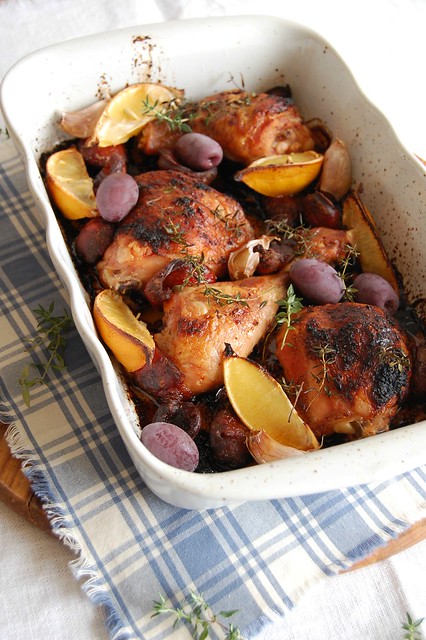
I like to use different recipes now and then and this one, from Donna Hay mag, was elected by the hubby as the most delicious roast chicken I've ever made, and he went crazy with the crunchy chorizo bits and the sweet and mellow roast garlic. We like our chicken very golden and crisp on the outside - hence the long oven time - but you can play around the recipe accordingly to your taste.
Chicken, chorizo and lemon bake
slightly adapted from the always delicious and foolproof Donna Hay Magazine
4 large pieces of chicken – I used 2 thighs and 2 drumsticks
For marinating the chicken:
2 garlic cloves, bashed in a mortar and pestle until puréed
juice of 1 large lemon
1 tablespoon olive oil
salt and freshly ground black pepper
For roasting the chicken:
1 lemon, sliced in 6 pieces lengthwise
1 chorizo, sliced
6 cloves of garlic, unpeeled
3 tablespoons unsalted butter, melted
6-8 sprigs fresh thyme
1/3 cup black olives
Place the chicken pieces in a plastic bag or in a shallow bowl. Add the garlic, lemon juice, olive oil, salt and pepper and mix to coat the chicken pieces. Close the bag (or cover the bowl with plastic wrap) and marinate in the fridge for 3 hours or overnight.
Preheat oven to 200°C/400°F. Remove the chicken from the marinade and place it in a shallow heatproof dish (if you line the dish with a double layer of foil washing up will be easier). Drizzle with some of the marinate and roast for about 40 minutes. Remove from the oven, add lemon, chorizo, garlic and thyme, drizzle with the butter and roast for another 40-50 minutes or until chicken is deeply golden brown and cooked through – in the final 10 minutes, add the olives.
Serves 2
Wednesday, June 29, 2011
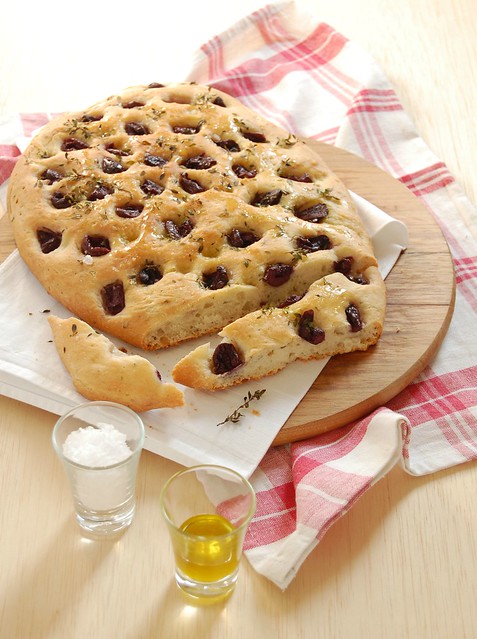
Olive and herb focaccia
I do not understand people who don’t like olives – don’t get me wrong, I have my own food pet peeves (won’t eat liver for the life of me), but olives are so juicy, so meaty and tender... I find them completely irresistible. ;)
That is why, while setting up the ingredients for this delicious bread, I pulled 20 olives out of the jar. :D
Olive and herb focaccia
slightly adapted from The Weekend Baker
Dough:
3 cups + 1 tablespoon (430g) all purpose flour
1 tablespoon minced fresh oregano or thyme
2 ¼ teaspoons (7g) dried yeast
2 teaspoons table salt
1 teaspoon superfine sugar
1 ¼ cups (300ml) warm water
1 tablespoon olive oil
Topping:
12-15 black olives, pitted and roughly chopped
1 ½ tablespoons olive oil
2 teaspoons fresh oregano or thyme leaves
1 teaspoon coarse salt – I used Maldon
In a large bowl, combine flour, oregano, yeast, salt and sugar. Stir to combine. Drizzle with the water and the olive oil and stir with a wooden spoon until a shaggy dough forms. Transfer to a lightly floured surface and knead until smooth and no longer sticky, about 10 minutes – resist the urge to add more flour; the dough is really soft so I preferred to use my Kitchen Aid with the dough hook to knead the dough.
Shape the dough into a ball and place into a lightly oiled large bowl. Cover with plastic wrap and let the dough rise in a warm spot until doubled in size, about 45 minutes.
Lightly oil a heavy cookie sheet. Turn the dough onto it and press gently to deflate. Shape into an oval about 2cm thick - the oval will be about 25cm (10in) long. Lightly brush the dough with olive oil and loosely cover the surface directly with plastic wrap. Let the dough rise again in a warm spot until puffed and almost double, about 20 minutes.
Preheat the oven to 220°C/428°F. Remove the plastic wrap from the dough. Lightly coat your middle 3 fingertips with flour and press into the dough down (but not through) the bottom. Repeat this dimpling all over the dough. Scatter the olive pieces over the surface, pressing them into the dimples. Drizzle the dough evenly with 1 tablespoon olive oil and sprinkle with the oregano and the coarse salt.
Bake until the top of the focaccia is golden and browned, 25-30 minutes. Remove from the pan and, using a large metal spatula, transfer the focaccia to a wire rack, drizzle with the remaining ½ tablespoon of olive oil. Serve warm (I found it delicious cold, too).
Makes 1 large focaccia
Friday, September 26, 2008
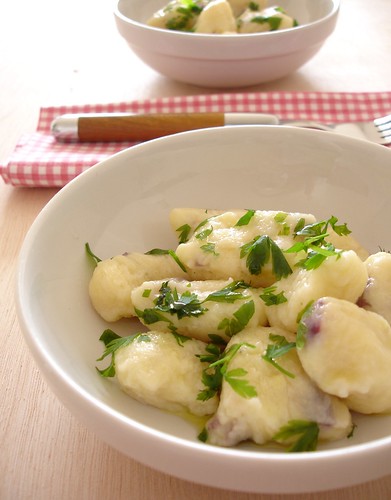
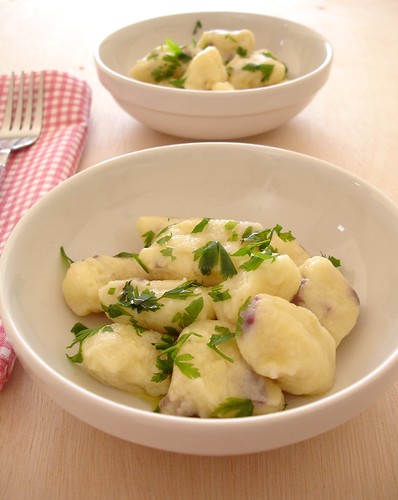
Olive gnocchi with parsley garlic sauce
Thank you all for being so supportive about my disastrous bread. I learned that KJ and Jenjen, two of my favorite bloggers, did not have any luck with this recipe either. And Syrie, tks for the suggestion of leaving Jamie a message – it had crossed my mind, but I thought I was being too childish... :)
With all the info I have received from you and from the people who read my blog in Portuguese, I ended up thinking that Jamie’s cooking recipes are great, but his baking recipes might not be all that. I say that because the complaints are about cakes and bread and not about pasta and salads.
Anyway, my new book has arrived and I am sure I’ll be baking some amazing bread this weekend. :)
I’ll offer you something savory today: a recipe adapted from here. I omitted the mushrooms just because I wasn’t in the mood for a grocery store trip. But even with this very simple sauce it was a good pasta dish – Joao had his gnocchi with tomato sauce and loved it.
I did have to use more flour than the amount called for in the recipe, but I believe it was the potatoes’ fault. Make sure you use potatoes that are suitable for gnocchi.
Olive gnocchi with parsley garlic sauce
from Australian Gourmet Traveller
Gnocchi:
800g (about 3) large desiree potatoes
3 egg yolks
80g (½ cup) black olives, pitted and finely chopped
110g plain flour*
salt
Sauce:
2 tablespoons extra-virgin olive oil
50g butter
3 cloves of garlic, thinly sliced**
1/3 cup (loosely packed) flat-leaf parsley, coarsely chopped
grated parmesan, to serve – I took the photo before adding the cheese, duh!
For gnocchi, bring potatoes to boil in a large saucepan, cook until tender (25-30 minutes). Drain, peel and pass through a potato ricer into a bowl while still hot. Beat in egg yolks and salt, add olives and flour and gently work mixture together. Turn onto a floured work surface and, using your hands, roll into 2cm-thick logs. Cut logs widthways into 1½cm pieces, pinch in the sides of each piece slightly and set aside.
Bring a large saucepan of salted water to the boil, add gnocchi and simmer over medium heat until they float to the surface (2-3 minutes). Transfer to a tray to keep warm.
Heat olive oil and butter in a large frying pan, when butter starts to foam, add garlic and cook, stirring occasionally, until soft (2-3 minutes). Add gnocchi, gently toss until coated, scatter with parsley, sprinkle with parmesan and serve immediately.
* I ended up using more flour because the dough was extremely soft
** I used garlic infused olive oil instead
Serves 6
Friday, August 1, 2008
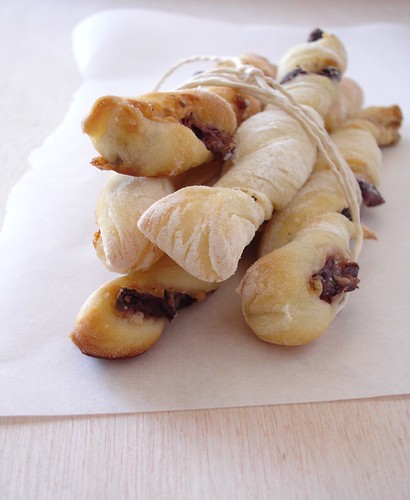
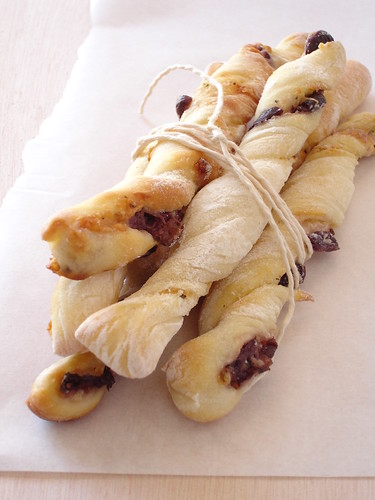
Waiter, there's something in my... picnic! Olive, herb and parmesan sticks
I haven’t taken part in blog events lately – I never seem to keep the deadlines in mind – but picnics are something I hold very dear and they are the theme for this “Waiter, there’s something in my...”, hosted by Johanna, Jeanne and Andrew.
When I was little, my parents used to take me and my brother to parks on the weekends, and we had wonderful picnics there (I once wrote about it here). To this day I can remember the towel over the grass and all the yummy snacks prepared by Mom – she was a magnificent cook/baker.
After she was gone, my paternal grandmother - who looked after us for a couple of years - would let my brother and I have picnics on the living room; she would lay the towel on the carpet for us to eat, just like my mom did on the grass.
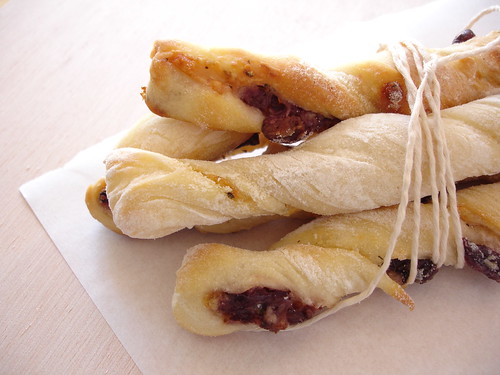
These delicious bread sticks are my contribution to the event. Just stay away from them as they come out of the oven – otherwise, there will be none left for the picnic.
Olive, herb and parmesan sticks
from Dough: Simple Contemporary Breads
Dough:
5g fresh yeast or ½ envelope (3.5g) active dry yeast – I used dry
250g white bread flour
1 teaspoon salt
¾ cup (180ml) water, room temperature
Filling:
¾ cup purple olives, such as Kalamata, with pits in
1 cup grated parmesan cheese
1 teaspoon herbes de Provence
cornmeal, for dusting – I didn’t have any at home, so I used flour instead
Start with the dough: using a mixer with the dough hook, put the flour in the mixer bowl and rub in the yeast (if using dry, just mix in). Switch the mixer onto the slowest speed, add the salt and then the water, and mix for 2 minutes, then turn up to the next slowest speed and mix for another 6-7 minutes until the dough becomes smooth and elastic. Remove the dough from the bowl, transfer to a lightly floured counter and mold into a ball.
Place in a lightly floured large bowl, cover with plastic/cling film and let rise in a draft-free area for 1 hour.
Make the filling: pit the olives and cut each one roughly into three (I cut into more pieces). Mix the olives, cheese and herbs together in a bowl. Set aside.
Assembling: with the help of the rounded end of your scraper, turn the dough onto the counter, lightly dusted with cornmeal. Using your hand, flatten out a rectangle about ¾-inch (2cm) thick. Sprinkle the filling on top and press it into the dough with your fingertips. Fold one third of the dough into the center and press down with your fingertips. Then fold the opposite side over on top (as if you were folding a letter to put into an envelope). Press with the palms of your hands to work the olives into the dough. With the flat edge of your scraper, cut the dough widthwise into 10-12 strips about ½-inch (1cm) wide. Flour the counter with cornmeal. Twist each strip (I pressed the sides together so the filling wouldn’t fall off) and roll them a little on the counter so they stretch to the length of your baking try (nonstick or covered with foil so the cheese in the dough won’t stick to the tray) and place the strips on top, leaving a gap between them – 1 inch (2.5cm) is fine.
Cover with a lintfree dishtowel and let rise for 30-45 minutes.
Preheat the oven to 220ºC/428ºF; put the baking dish into the oven and mist the inside with a water spray. Bake for 10-12 minutes or until golden brown.
Use a spatula to lift them from the baking tray. Cool on a wire rack.
Makes 10-12 – I got 16
Tuesday, April 29, 2008
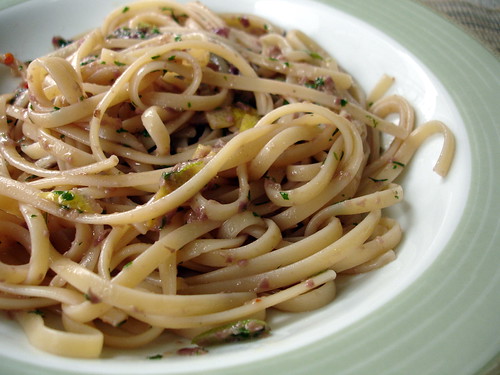
Linguine with olives, thyme and lemon
Some people hate Martha, but I’m one of those who love her. :)
I got this recipe from her website; the original version calls for pappardelle, but I chose to use linguine (one of my favorite pasta shapes). I think the substitution worked well.
It is a quick, easy to put together sauce and it smells wonderful, but one thing that didn’t please me much was finding large pieces of zest in my pasta – as much as I love lemons and oranges, I’m sure that the result would have been a lot better if grated zest had been used instead of chopped.
This is my entry for the Weekend Herb Blogging, this time hosted by the adorable Anh, of Food Lover’s Journey.
Linguine with olives, thyme and lemon
½ teaspoon coarse salt– I used sea salt
225g (8 oz) linguine
16 Kalamata olives, pitted
½ cup fresh flat-leaf parsley
2 tablespoons extra-virgin olive oil
1 tablespoon fresh thyme leaves
zest of 1 lemon, coarsely chopped
one 3-inch piece orange zest, coarsely chopped
¼ teaspoon crushed red-pepper flakes
Bring a large pot of water to a boil. Add salt and the linguine, and cook until pasta is al dente, following label directions. Drain in a colander.
While pasta is cooking, combine salt, olives, parsley, olive oil, thyme, lemon zest, orange zest, and red-pepper flakes in the bowl of a food processor fitted with the steel blade. Pulse until a chunky puree forms. Transfer to a warm serving bowl large enough to accommodate cooked pasta.
Add pasta, and toss to combine.
Serve immediately.
Serves 2, or 4 to 6 as an appetizer
Thursday, February 7, 2008
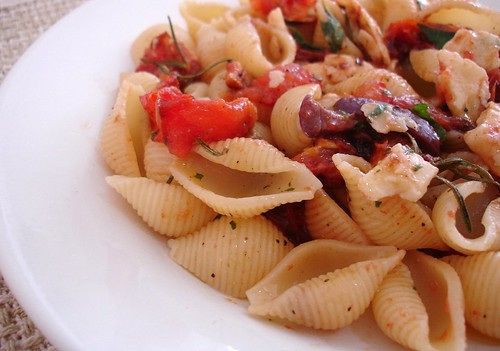
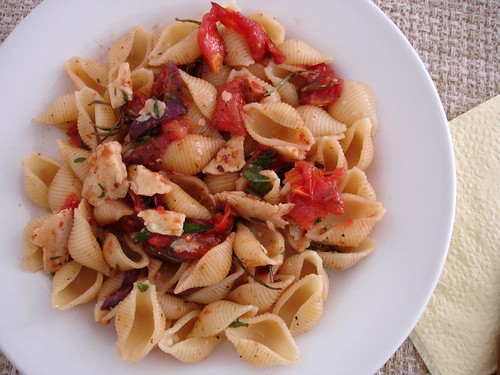
Pasta with tomatoes, olives, grana padano and basil
Joao loves pasta but he’ll mostly have it with tomato or bolognese sauce. He tried pesto when I first made it and liked it, but still looks at other pasta possibilities very suspiciously. That’s silly and I always tell him that.
So when I choose different pasta recipes to try he goes all “I want mine with bolognese sauce, please” and I go “ok, same old pasta for you, mister”. I won’t force him - mom made me eat beef so many times as a kid and I never learned to like it.
But things seem to be slowly changing around here… Bill’s pasta smelled so great that while eating I noticed a fork “stealing” spaghetti from my plate. And it happened with this pasta dish, too: every time I looked at my plate there was less food there – the fork had attacked again! I looked at Joao with angry eyes but it didn’t work. :)
I adapted a recipe found on a Portuguese food magazine called Blue Cooking and this is my entry for the Weekend Herb Blogging, this time hosted by Ulrike, from Kuchenlatein.
Pasta with tomatoes, olives, grana padano and basil
400g short pasta – choose the one you like the most
60g black olives, pitted and roughly chopped
500g ripe tomatoes, cut in 8 parts each (half moons)
salt
freshly ground black pepper
rosemary leaves
½ cup (120ml) extra virgin olive oil + extra olive oil to drizzle
4 garlic cloves
200 grana padano cheese, in shavings
1 handful basil leaves
Preheat the oven to 200ºC/400ºF. Lightly oil a baking dish and place the tomatoes on it; sprinkle with salt and pepper and set aside.
Peel and cut the garlic cloves so there is one piece of garlic for each tomato slice. Place the garlic on the tomatoes, add some rosemary leaves on top, drizzle with olive oil and bake for 10 minutes or until the tomatoes are tender and the skin starts to blister. Remove from the oven, allow to cool then tear them into pieces. Set aside.
Meanwhile, cook the spaghetti in a large saucepan of boiling salted water until al dente.
Place the basil in a small bowl, add the ¼ cup olive oil and process using an immersion blender – I halved the recipe and made the basil oil using a mortar and a pestle; a small processor would do the job, too.
Drain the pasta, add the olives, the reserved tomatoes, the cheese and the basil oil and gently toss the ingredients together. Serve at once.
Serves 4