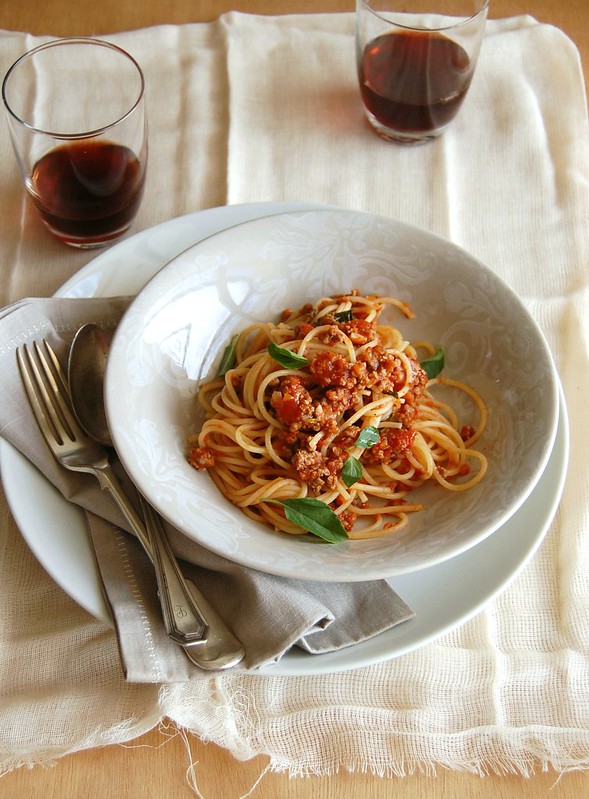
I was going through some old photos I made for the blog (or for the book, when I still considered writing one), and found today’s photo: a lentil Bolognese that I tested a few times and turned out quite tasty. I liked it a lot, but my husband not so much: he is not addicted to meat and does not mind at all eating without it most days, but he is not very much into lentils. I ended up forgetting about the recipe, and also because the name kind of bugged me a bit: it is a delicious and nutritious sauce, but it has nothing to with the once made with mince beef.
Since then, time flew, lots of things happened, I became lactose intolerant and started drinking plant based milks – they saved my beloved lattes in the morning – and I realized that I had to stop lecturing so much. If people want to call those plant based beverages “milk”, what is the issue? Same for calling this sauce “bolognese” – no worries anymore. I don’t want to be that person – if you have read my blog long enough you will probably have seen me being a dick a couple of times about something (excuse my French), so I apologize now. I want to be a better person.
I decided to post this recipe because I believe that it might come in handy for those quarantined like me, who don’t have mince beef in their fridge or freezer. I must confess that I wasn’t very fond of this sauce on pasta, but it was delicious over soft polenta.
Lentil bolgonese
own recipe, inspired by several recipes
For the lentils:
2 cups water
pinch of salt
½ cup dried green lentils
1 garlic clove, peeled and sliced in half
Sauce:
1 ½ tablespoons olive oil
½ medium onion, finely diced
2 small celery sticks, finely diced (1/4 cup after they are diced)
2 large garlic cloves, finely diced
2 tablespoons dry red wine
1 can (400g) peeled tomatoes, chopped
3 sprigs fresh thyme
1 bay leaf
sal and freshly ground black pepper
handful fresh basil leaves
Start by cooking the lentils: place the water in a small saucepan and heat over high heat. When it starts to boil, add the lentils, garlic and salt and cook, stirring occasionally, for 15 minutes or until lentils are al dente. Drain and rinse under cold water to stop the cooking process. Remove the garlic – you won’t need it anymore.
Now, the sauce: heat the olive oil in a medium saucepan over medium-high heat. Add the onion and the celery and cook, stirring occasionally, until they are tender. Add the garlic and cook for 1 minute – do not let it burn or it will give the recipe a bitter taste. Add the wine and cook for 2 minutes. Add the canned tomatoes, the thyme, the bay leaf, the sugar, season with salt and pepper. When it starts to boil, turn down the heat and simmer, stirring occasionally, for 20 minutes. Add the lentils and cook for another 5 minutes. Check the seasoning, remove the thyme sprigs and the bay leaf, add the basil and serve.
Serves 4 over soft polenta, 2 served with pasta
Tuesday, April 28, 2020
Lentil bolgonese and trying to be a better person
Monday, February 19, 2018
Pasta with onion and tomato sauce and the change in my cooking habits
I was talking to my husband the other day about how my cooking and baking have changed in the past year or so: I don’t bake as much anymore (lack of time + my lactose intolerance) and I also don’t test so many new recipes as I used to. Sometimes I flip through my books and magazines and the photos make me drool, however, I have been feeling the need of eating dishes I am familiar with.
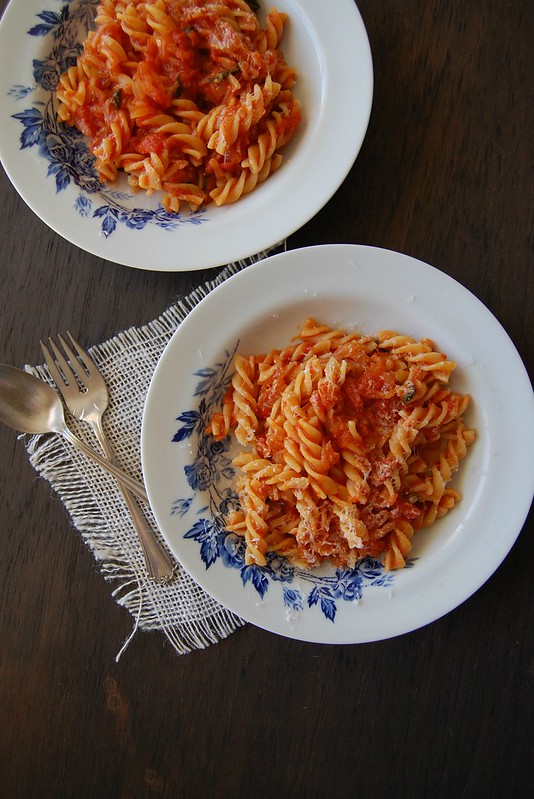
I keep coming back to recipes I call “the classics” at my house, food that comforts and nourishes. Tomato sauce is something I make quite regularly (also to keep some in the freezer for emergencies or lazy days/nights), but there are times I vary it a bit (when I am not pressed for time) and make the recipe I bring you today: it is delicious and a hit with my husband and I – we are both dying hard onion fans. What I love to use with this sauce is orecchiette, for they are like small pools of sauce. :)
Pasta with onion and tomato sauce
slightly adapted from the wonderful Antonio Carluccio
2 tablespoons olive oil
2 medium onions (300g), peeled, cut in half and finely sliced into half-moons
1 tablespoon dry red wine
1 400g (14oz) can peeled chopped tomatoes
1 tablespoon tomato paste
1 teaspoon granulated sugar
1 bay leaf
salt and freshly ground black pepper
handful of fresh basil leaves
200g short pasta
finely grated parmesan or pecorino, to serve
Heat the oil in a large nonstick saucepan over medium-low heat, add the onions and fry them very gently until they become transparent and soft, about 20 minutes – stir occasionally so the onions do not catch in the pan. Add the wine and deglaze the pan. Add the tomatoes and tomato paste, followed by 1/3 of the can filled with water, the sugar, the bay leaf, season with salt and pepper and continue to cook, now on a low heat, for 15 minutes. Stir in the basil and turn of the heat.
In the meantime, cook the pasta in plenty of boiling salted water until al dente (follow the instructions in the package). Drain well, then mix with the sauce and stir to coat all the pasta. Serve immediately with finely grated parmesan or pecorino.
Serves 2
Friday, May 5, 2017
My Bolognese sauce, as per my husband's request
I started blogging about food in 2006 (sometimes I find it hard to believe I am still here, to be honest) and for years now many people have written to me to tell me they learned how to cook with me (Brazilians, since I write in Portuguese, too). Every time I read the emails I feel joy in my heart, for I know how liberating learning how to cook can be – it was for me.
So here we are, almost eleven years later, and this time the “revolution” is happening in my home: my husband has been learning how to cook. :) It started with sandwiches, it evolved to salads and soups (very good salads and soups, by the way) and days ago he tried to make one of our favorite dishes: Bolognese sauce. I arrived home late after a tiresome day at the office and smelled something wonderful when the elevator door opened – for a moment I thought the smell could be coming from my neighbors’, but those people, besides being incredibly noisy and rude, don’t cook food that smell that great. :)
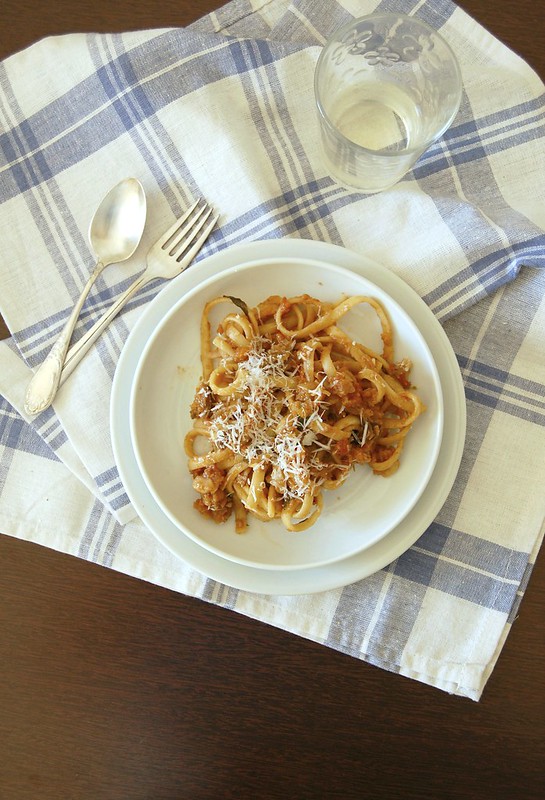
For my surprise, the smell was coming from my apartment and as I walked in I found my husband smiling at me: “surprise! I made your Bolognese sauce!” – I helped him cook the linguine and we had a delicious dinner.
He then told me he was a bit confused during the preparation of the sauce and that he had searched the blog to make sure he remembered all the steps – “I could not find the recipe on TK”, he said, and I told him I had not published it here. He said “it’s about time”, so here we are: I am sharing with you my Bolognese sauce – and I call it “my Bolognese” because I know it is not the most authentic one out there, but it is the one I have been making for years and that my husband loves so much. I don’t always have carrots and/or celery at home for the sofrito, so onions and garlic are the aromatics of choice; also, I hardly ever have 3 hours to wait for the sauce to come together, so mine is ready in 30 minutes or so. I hope you give it a go and if you do, please let me know how it went.
My Bolognese sauce
own recipe
1 ½ tablespoons olive oil
1 large onion, finely diced
3 large garlic cloves, minced
250g beef mince
salt and freshly ground black pepper
¼ cup (60ml) dry red wine
1 tablespoon tomato paste
1 400g (14oz) can peeled tomatoes
1 tablespoon granulated sugar
2 bay leaves
5 sprigs of fresh thyme
handful of fresh basil leaves or fresh oregano leaves
300g linguine
In a medium saucepan, heat the olive oil over medium-high heat. Add the onion and cook until translucent, 4-5 minutes. Add the garlic, cook for 1-2 minutes or until fragrant, then add the beef and break it down with the spoon into smaller pieces. Cook, stirring occasionally, until beef is well browned. Season with salt and pepper. Stir in the wine and cook again for 2-3 minutes or until wine is reduced – using a wooden spoon, scrape the brown bits in the bottom of the saucepan for extra flavor.
Add the tomato paste and cook for 1 minute. Stir in the canned tomatoes and smash them with a potato masher. Fill ¾ of the can with water, swirl it around and add to the saucepan. Season again with salt and pepper, add the sugar, the bay leaves, the thyme and cook over low heat, stirring occasionally, for about 30 minutes or until thickened. Add the basil/oregano, stir to combine, remove the bay leaves and the thyme sprigs, cover and remove from the heat.
Cook linguine in a large pot of salted boiling water until al dente. Drain and stir in the sauce. Serve immediately.
Serves 3
Thursday, October 20, 2016
Linguine with creamy tomato, thyme, caper and bacon sauce
I believe that many of you reading me right now reach for a pasta package whenever there is the need of having food on the table in little to no time – I am guilty of that and I am not ashamed of it. :)
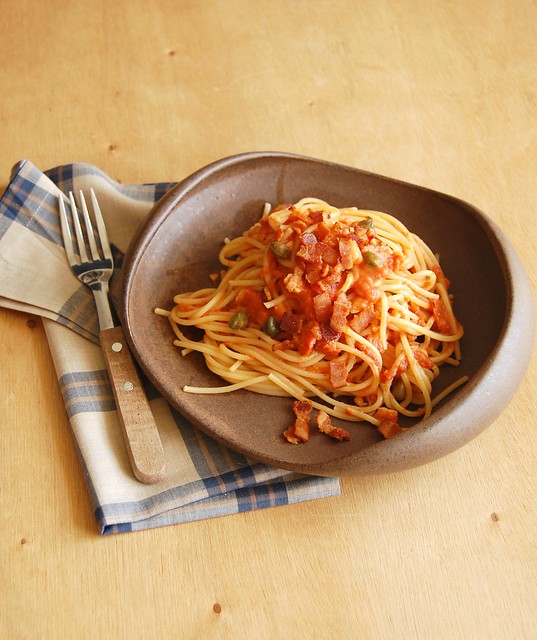
I make pasta often not only because of how fast it is: Joao and I love it and it is so versatile I can combine it with several different flavors and types of sauce. I saw this version of a tomato sauce on Olive magazine and it was so simple I had to try it: the sauce is delicious, the acidity of the tomatoes is softened by the addition of cream and the capers add a briny, salty touch to the sauce. Thyme is my favorite herb and one I love pairing with tomato.
Linguine with creamy tomato, thyme, caper and bacon sauce
slightly adapted from the always great Olive magazine
4 slices of bacon, cut into ½ cm pieces
2 large garlic cloves, crushed
6 sprigs of fresh thyme
1 x 400g can of chopped tomatoes
2 teaspoons granulated sugar
salt and freshly ground black pepper
2 tablespoons capers – soak them in cold water for 15 minutes before using, then drain
3 tablespoons heavy cream
200g linguine
In a medium saucepan, over high heat, cook the bacon, stirring occasionally, until crisp. Remove from the pan and set over paper towels. Remove the excess fat from the saucepan, leaving 1 tablespoon. On that fat, cook the garlic until fragrant, about 1 minute. Stir in the thyme and cook for 1 minute. Add the tomatoes, crush them with a potato masher, then fill the can by half with water and add to the tomatoes. Add the sugar, season with salt and pepper and cook partially covered, stirring occasionally, for about 20 minutes or until thickened.
In the meantime, cook the linguine in salted boiling water until al dente.
Stir in capers and cream and then cook for 3 minutes. Drain the linguine and toss with the sauce. Serve at once sprinkled with the bacon bits.
Serves 2
Tuesday, June 21, 2016
Linguine with chorizo tomato sauce
Even though I haven’t had the time to post here as often as I would like to, I have been cooking and baking quite regularly – family and friends thank me for that. ;)
I have been, however, a bit tired (too much work, I guess): days ago I was watching a rerun of Law & Order: Criminal Intent (you know how much I love that show!) and it took me a good while to recognize Carrie Preston in the episode: I was sure I knew her from somewhere, but she was a blonde then and without Arlene’s bold red hair my brain was very slow in processing the info. :D
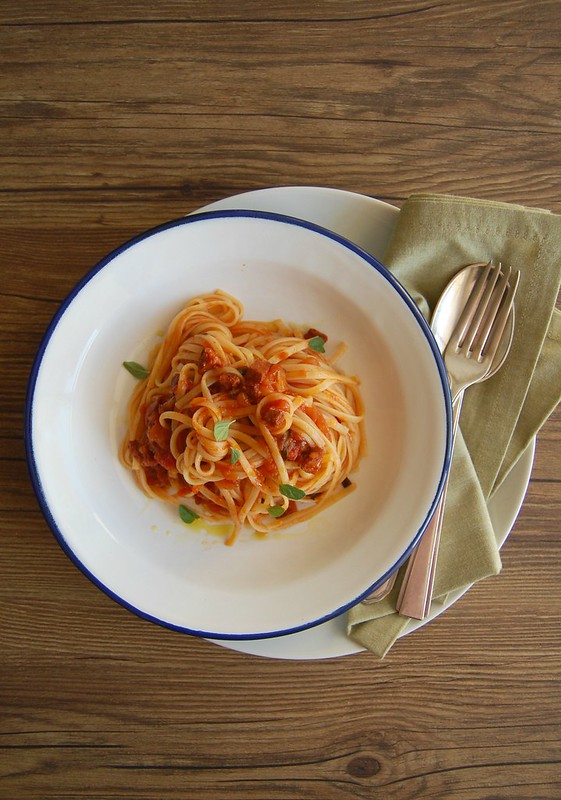
And speaking of bold red hue, may I introduce you to the dish I made last weekend that got my husband asking for seconds? The idea was to make bolognese pasta, but when we arrived at the shop the meat grinder was broken. I’d already decided to make a simple tomato sauce when I opened the fridge to get the onion and garlic and spotted a piece of chorizo right there, in front of me – I chopped it in small cubes and used it to replace the beef mince. A bit of sherry to make things more Spanish, a handful of marjoram – a herb that I love pairing with pork – and lunch was served.
Linguine with chorizo tomato sauce
own creation
1 ¼ cups (175g) diced chorizo
½ large onion, finely diced
2 large garlic cloves, minced
2 tablespoons sherry
1 ½ tablespoons tomato paste
1 400g (14oz) can peeled tomatoes
1 tablespoon sugar
salt and freshly ground black pepper
2 bay leaves
handful of fresh marjoram leaves
300g dried linguine or other long pasta shape you prefer
parmesan or pecorino, to serve
Heat a medium saucepan over medium/high heat and add the chorizo. Cook until it releases its oils and starts getting crispy. Add the onion and cook until soft, 4-5 minutes, stirring occasionally so it doesn’t catch in the bottom of the pan. Add the garlic and cook until fragrant, about 1 minute.
Add the sherry and cook until reduced, about 2 minutes. Stir in the tomato paste, cook for 1 minute, then add the tomatoes and crush them with a potato masher. Fill the can by half with water and add to the sauce. Stir in the sugar, season with salt and pepper – gently, since the chorizo is already salty and spicy – and add the bay leaves and the marjoram. Cook over low heat, partially covered, stirring occasionally, for about 20 minutes or until slightly thickened.
In the meantime, cook the linguine in a large pot of boiling salted water until al dente, about 10 minutes (check the package instructions). Drain the linguine and stir it into the sauce. Serve immediately sprinkled with freshly grated pecorino or parmesan, or for an even more Spanish touch, manchego chese.
Serves 3
Monday, March 28, 2016
Spaghetti with meat and aubergine balls
I once told you that meatballs are a huge success at home, and I was not lying: I make them quite often, and always pop some of them (still uncooked) in the freezer – they can go to the oven directly from frozen, making my life a lot easier during weeknights (+ my husband can do that himself, which is always a plus). :)
I have posted meatballs made of beef, and meatballs made of eggplant, and today I present you a merge between those two kinds: eggplants get roasted, then their pulp is mixed with beef to create delicious, moist meatballs – they were very flavorsome and turned the spaghetti into something even more special.
Since this is a recipe by Antonio Carluccio there was no way it could go wrong.
Spaghetti with meat and aubergine balls
from the always delicious and beautiful Pasta
400g spaghetti
freshly grated parmesan or pecorino, to serve
Sauce:
2 tablespoons olive oil
1 large onion, finely chopped
2 large garlic cloves, finely chopped
100ml dry red wine
2 tablespoons tomato paste
680g tomato passata
salt and freshly ground black pepper
2 teaspoons granulated sugar
handful fresh basil leaves
Meatballs:
2 whole aubergines
olive oil, for drizzling the aubergines and for shallow-frying
300g minced beef
1 garlic clove, peeled and squashed to a paste
¼ teaspoon freshly grated nutmeg
50g parmesan, finely grated
1 egg, lightly beaten with a fork
100g fresh breadcrumbs
1 teaspoon table salt
freshly ground black pepper
Preheat the oven to 180°C/350°F. Line a large baking sheet with foil and brush it with olive oil. Cut the aubergines in half lengthwise and place them cut side up onto the foil. Drizzle with 2 tablespoons olive oil and bake for 30-40 minutes. Scoop the pulp out of the skins, transfer to a large bowl and mash the pulp. Cool. Discard the skins.
While the aubergines are roasting, make the sauce: heat the olive oil in a large saucepan, and fry the onion until soft, about 5 minutes. Add the garlic and cook until fragrant, about 1 minute. Add the wine and cook for 1 minute. Add the tomato paste and tomato passata. Season with salt and pepper, add the sugar, stir well and cook gently for 30–40 minutes. Stir in the basil and remove from the heat.
Meanwhile, continue with the meatballs by mixing together the beef mince, the aubergine pulp, garlic, nutmeg, parmesan, egg and breadcrumbs. Season with salt and pepper, mix well and shape into balls. Shallow-fry in olive oil to brown on all sides. Add the balls to the tomato sauce and keep warm.
Cook the pasta in plenty of boiling salted water until al dente. Drain. Mix the past and the sauce carefully and serve immediately sprinkled with parmesan or pecorino.
Serves 4
Thursday, April 30, 2015
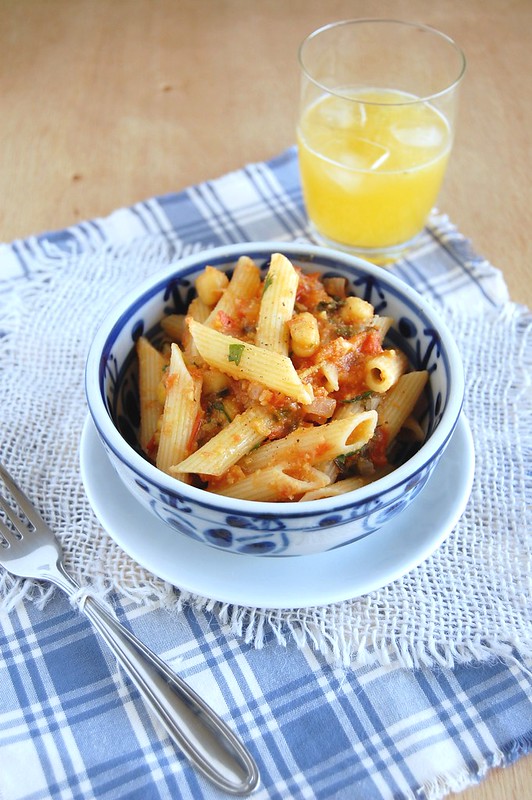
Penne with tomato and chickpea sauce - simple, honest food
Because I like to try new recipes and new dishes I look for inspiration everywhere, even in cuisines I would never adopt as a way of life, such as vegan, for instance: I understand that there are great vegan recipes out there and I have made some myself, but I don’t intend to spend my life without milk, eggs, honey, butter or cheese – it’s just not who I am.
Having said that, I got curious when I read a recipe on Andrew Carmellini’s beautiful Urban Italian for a dish pasta that was rich without having loads of butter and cream – yes, I won’t give up on cream, that is for sure, but that doesn’t mean I have to eat it every single day. I am a sucker for pasta dishes, so I gave it a go and it turned out delicious: the chickpea puree thickens the tomato sauce in a lovely way, making it velvety, and the bacon (that I used instead of the sausages called for in the original recipe) adds a nice, salty touch.
This is simple, no fuss, honest food that I am eager to eat on a daily basis – I could not expect less from the guy responsible for the best gnocchi.
Penne with tomato and chickpea sauce
adapted from the delicious Urban Italian: Simple Recipes and True Stories from a Life in Food
1 can (420g/15oz) chickpeas
½ tablespoon olive oil
2 bacon rashers, finely sliced
3 cups your favorite tomato sauce – mine is here
½ teaspoon fennel seeds, ground
salt and freshly ground black pepper to taste
¼ teaspoon red pepper flakes
400g penne
2 tablespoons unsalted butter
2 teaspoons extra virgin olive oil
1 cup grated pecorino cheese
Drain the chickpeas well, reserving the liquid. Blend half the chickpeas (about 1 cup) and half their liquid on high until the mixture forms a smooth paste, about 1 minute.
Heat the olive oil in a large saucepan over high heat. Add the bacon and cook until crisp. Add the tomato sauce and stir to combine. Add the chickpea puree and the fennel seeds and stir to combine. Season to taste, then cook over medium heat stirring occasionally until the mixture forms a loose sauce and the flavors are combined, about 15 minutes. Stir in the pepper flakes and the remaining chickpeas and remove from the heat.
Cook the penne in a large saucepan of salted boiling water until al dente. Drain but do not rinse the pasta.
Return the rigatoni to the pot. Add the sauce and cook on medium-high heat, mixing well, until the pasta is well coated, about 1 minute. Remove the pot from the heat and stir in the butter, olive oil and half the pecorino cheese. Transfer the pasta and sauce to a large serving dish and top with the rest of the pecorino cheese and serve immediately.
Serves 4
Monday, January 19, 2015
Meatballs alla Norma
As someone who loves anything related to food, I love reading about it, making and eating it (obviously), but I also find it amazing to talk about it with different people and learn what they like, what they don’t like and how their tastes change with time.
I have those conversations with my husband all the time, and he tells me about the food he ate as a kid, things he loved and things he couldn’t stand, how it took him so long to appreciate all sorts of vegetables, and that his mother would be really glad to see him finally eating like an adult (she passed away in 2011).
Every time Joao and I talk about those things I feel more inspired to cook, and when he asked me to make meatballs – one of his all time favorite dishes – I remembered Jamie Oliver’s meatballs alla Norma and thought that a bit of eggplant in the meatballs wouldn’t hurt.
I love eggplant. :)
The eggplant sauce tasted divine with the meatballs; Jamie served his over polenta, but since it was too hot here I went with spaghetti instead and some bread to mop up the sauce – a simple yet delicious meal that I get to replicate anytime I want with the meatballs I stashed in my freezer.
Meatballs alla Norma
slightly adapted from the always delicious Save with Jamie: Shop Smart, Cook Clever, Waste Less
Meatballs – recipe here
Sauce:
1 large eggplant
olive oil
2 cloves garlic, minced
2 tablespoons sweet chili sauce
2 tablespoons balsamic vinegar
1 400g (14oz) can diced tomatoes
salt and freshly ground black pepper
handful fresh basil leaves
Dice the eggplant into 1.5 cm cubes, then season well with salt and leave for 15 min in a colander.
Preheat the oven to 200°C/400°F. Line a large baking sheet with a double layer of foil and brush it with olive oil. Place the meatballs onto the prepared sheet and bake until firm and cooked through (about 30 minutes) – bake as many as you want, the recipe yields about 25 meatballs. You can freeze uncooked meatballs for up to 2 months and bake them directly from frozen.
While the meatballs are in the oven, make the sauce: take handfuls of the eggplant and squeeze out the excess salty liquid, then put into a saucepan on a medium heat with a lug of oil to cook for 10 min, or until golden, stirring occasionally. Add the garlic and cook until fragrant. Stir in the sweet chili sauce and balsamic, add the tomatoes and 3 tablespoons water. Season with salt and black pepper, then simmer for 10-15 min, or until thickened. Stir in the basil and remove from the heat.
Add the meatballs to the sauce and serve immediately.
Serves 4
Wednesday, August 6, 2014
Polenta and ricotta chips and cooking from scratch
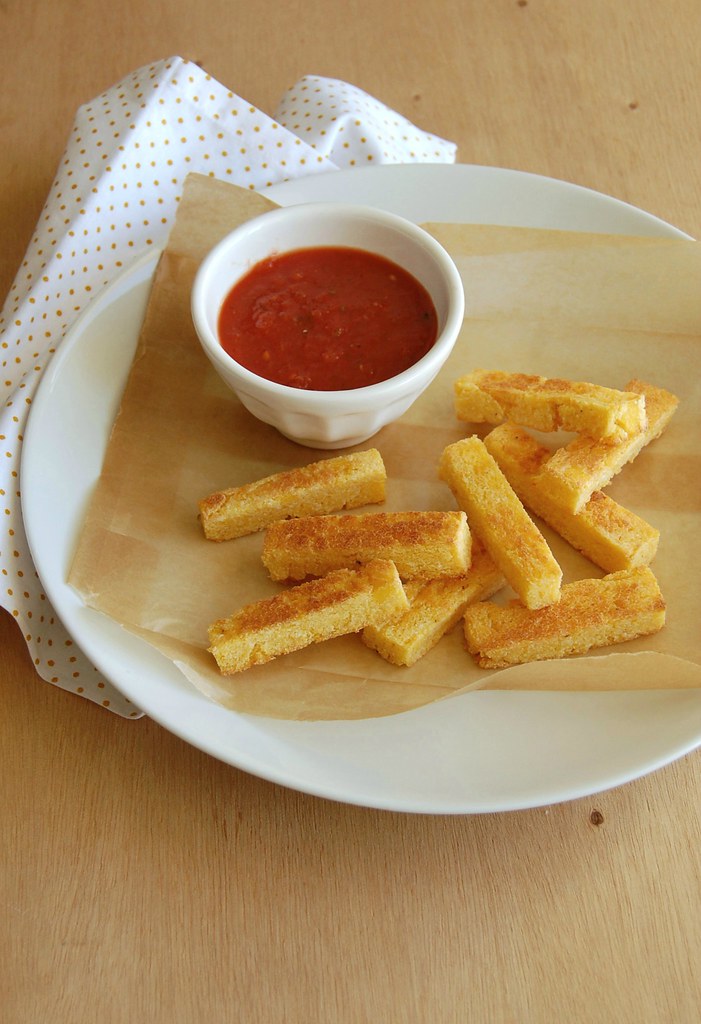
As I told you yesterday, I love making things from scratch if and when I have time for that, and the recipe I bring you today is a good example of that: in these delicious polenta and ricotta chips, I used homemade vegetable stock, homemade ricotta and homemade tomato sauce.
The vegetable stock is a precious hint I got from a good friend of mine: she makes her stock with the skins peeled off the vegetables (carrots and potatoes, for example), mushroom stems, parsley and basil stalks, the green end of leeks, that is, all the tidbits that would end up in the garbage. I’ve been making stock her way for a long time and always have some stashed in the freezer, and that is the one I used to cook this polenta.
The tomato sauce is the one I make over and over again, with canned tomatoes and lots of fresh basil, oregano and thyme, and it’s the one my husband eats by the spoonful if left to his own devices – if there’s bread in the house I have to make sure he doesn’t eat the whole batch of sauce with it before I even have the chance to proceed with whatever I was making in the first place. :D
And the ricotta is a recipe from the wonderful Donna Hay magazine I got years ago, 2009 to be more precise, and from that moment on I’ve never used store-bought ricotta again – I’ve been using this homemade ricotta for all sorts of things, always with amazing results. It has great texture and flavor and it is quick to make. Back then I used to line the colander with fine muslin, but a while ago I bought a fine mesh strainer and it does the job perfectly without the cloth.
This post might sound like a nightmare for those of you who don’t like making things from scratch, and I’m not here to preach, but believe me when I say that besides tasting a lot better than the store-bought versions they’re all easy to make – not to mention they’re very budget friendly, especially the vegetable stock.
I know it may seem like a bore to turn each polenta chip after their first 20 minutes in the oven, but that was the way I found to make them crisp and golden without frying (which was called for in the original recipe) – please don’t hate me. :)
Polenta and ricotta chips
slightly adapted from the always wonderful Donna Hay magazine
2 cups (500ml) vegetable stock
1 cup (170g) instant polenta
1 cup (80g) finely grated parmesan
25g butter
salt and freshly ground black pepper
200g ricotta*
canola oil, for brushing
tomato sauce, for serving
Place the stock in a large saucepan over medium heat and bring to the boil. Gradually add the polenta, whisking continuously for 2–3 minutes. Remove from the heat and stir through the parmesan, butter, salt and pepper. Allow to cool for 5 minutes. Add the ricotta and fold through to combine. Spoon and press the polenta into a lightly buttered 20cm (8in) square cake pan and refrigerate until set, about 1 hour.
Preheat the oven to 200°C/400°F. Line a large baking sheet with foil and brush it lightly with oil.
Remove the polenta from the pan and slice into thick chips. Arrange them on the prepared sheet 1cm apart. Bake for 20 minutes, then carefully turn each chip and bake for another 20 minutes or until golden and crisp.
Serve immediately with the tomato sauce.
* I used homemade ricotta: 3 cups (720ml) whole milk = 200g ricotta
Serves 4
Wednesday, June 4, 2014
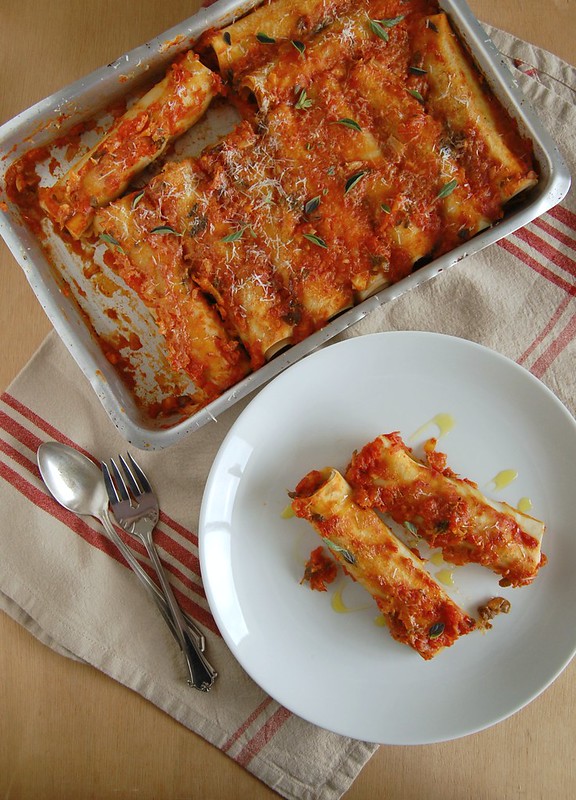
Beef and mushroom cannelloni and things worth trying
When I look at this recipe I think of the phrase “when life gives you lemons, make lemonade”, but in a slightly different way: if your husband tried mushrooms for the first time and liked it, add them to your food every chance you get. :D
After the success I had with the vegetarian bolognese, I could not wait to cook with mushrooms again, and the inspiration came right from the first pages of this wonderful cookbook – I am the kind of person so crazy for mince that buys a cookbook on the subject. :)
After I finished cooking the filling, it smelled and tasted so good I felt like eating it with some bread, sloppy joe style, and it could have been tossed with some spaghetti, too, for a very quick meal (just some ideas if you’re not in the mood for rolling cannelloni).
For years my husband did not understand my love for TV series, and of course he wouldn’t because he had never given the shows a try. That changed when I got him to watch The Blacklist with me – he got hooked on Raymond Reddington’s adventures as much as I did, and he liked the show so much we now watch Resurrection together as well.
I guess that in life one should try things before knocking them, either if they’re food or TV shows – and this dish I bring you today is well worth trying.
Beef and mushroom cannelloni
adapted from the great Mincespiration!
tomato sauce, made with 1 ½ cans (400g each can) peeled chopped tomatoes (save the remaining ½ can for the filling), warm
olive oil
200g button mushrooms, wiped and chopped
salt and freshly ground black pepper
300g beef mince
1 onion, finely chopped
3 fat garlic cloves, crushed
80ml white wine
½ can peeled chopped tomatoes
handful fresh oregano leaves
500g fresh lasagna sheets
about 50g Parmesan cheese, finely grated
Preheat the oven to 200°C/400°F.
Heat 1 teaspoon olive oil in a large non-stick frying pan and fry the mushrooms until browned. Season with salt and pepper. Remove the mushrooms from the pan and set them aside. Using the same pan, add a little more oil and fry the beef for 4-5 minutes until browned. Add the onion and garlic and continue cooking for 2-3 minutes. Season with salt and pepper. Pour in the wine and cook until the liquid is reduced by half, then add the chopped tomatoes and the oregano and cook for 5 minutes, stirring occasionally. Put the mushrooms back in the pan and cook for 1 minute or until liquid is almost completely absorbed. Remove from the heat and cool slightly.
Spread half the tomato sauce on the bottom of a 20x30cm (8x12in) baking dish or pan.
Lay a sheet of lasagna on a board, spoon on some filling, top with a little parmesan and roll up, forming a cylinder. Repeat with the remaining pasta sheets and filling. Place the cannelloni in the baking dish on top of the tomato, the cover with the remaining sauce and sprinkle with the remaining parmesan. Bake for about 30 minutes or until bubbly and pasta is cooked.
Serves 5-6
Friday, May 9, 2014
Linguine with porcini and vegetable bolognese, soothing simplicity and striking complexity
“Sweet Sixteen” is not the only song I listen to five, six times in a row – I have other old favorites, songs that are so perfect to me that I hit the repeat button as soon as they start playing.
However, not all of them are as simple as Billy Idol’s beautiful creation: there are times when the only thing I want to listen to is Marc Almond’s powerful vocals, backed up with those loud and vibrant arrangements.
“Loving You, Hating Me” is a song I deeply love (as some of you already know), and I think it gets even more fantastic in the last one and a half minutes, with the arrangement going wild and Marc’s voice doing the same – depending on my mood I have to be careful not to sing it at the top of my lungs (which can be tricky if there are other people nearby). :D
There are days for Billy’s soothing simplicity, and there are days for Marc’s striking complexity, just as there are days for good old bolognese sauce and days for this delicious vegetarian version – it took me nine years to convince my husband to eat mushrooms and this was how I managed to do it (for the record, he loved the sauce and could not believe how tasty it was even though there wasn’t one single gram of meat in it). :)
Linguine with porcini and vegetable bolognese
slightly adapted from the amazing Delicious Australia
15g dried porcini mushrooms
400g linguine
2 small carrots, roughly chopped
1 large onion, roughly chopped
200g button mushrooms
2 garlic cloves, roughly chopped
2 tablespoons olive oil
handful of fresh basil leaves, chopped
2 tablespoons fresh oregano leaves
½ cup tomato sauce – I used homemade
½ cup (120ml) red wine
3 tablespoons water
½ cup sour cream*
grated parmesan or pecorino, to serve
Soak porcini in ½ cup (120ml) boiling water for 10 minutes. Drain, reserving the liquid, and chop.
Whiz carrot, onion, mushrooms and garlic in a food processor to finely chop.
Heat the oil in a large saucepan over medium-high heat and add the finely chopped vegetables. Cook, stirring, for 3-4 minutes until softened. Add the herbs, tomato sauce and drained porcini, then cook, stirring, for 1 minute or until fragrant.
Add the wine, water and reserved porcini liquid. Season with salt and pepper, then reduce heat to low and simmer for 5 minutes or until slightly thickened. Stir through the sour cream and cook for 2 minutes.
In the meantime, cook linguine in a large saucepan of boiling, salted water according to the packet instructions.
Drain the linguine, reserving a little of the cooking water, and add it to the sauce. Toss to coat, adding the reserved water, if needed (I did not). Serve with the parmesan or pecorino (I used the latter).
*homemade sour cream: to make 1 cup of sour cream, mix 1 cup (240ml) heavy cream with 2-3 teaspoons lemon juice in a bowl. Whisk until it starts to thicken. Cover with plastic wrap and leave at room temperature for 1 hour or until thicker (I usually leave mine on the counter overnight – except on very warm nights – and it turns out thick and silky in the following morning; refrigerate for a creamier texture)
Serves 4
Friday, March 28, 2014
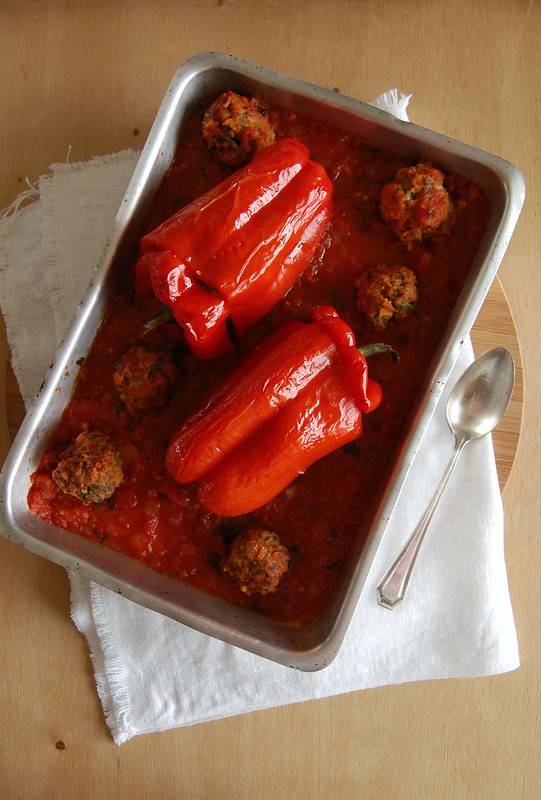
Chorizo, beef and couscous stuffed peppers - dedicated to two certain kids
As I was reading the “news” days ago on People online, I found out that Gwyneth Paltrow and Chris Martin have separated. Ok, alright, divorces happen, they’re part of life. People are already making fun of their “conscious uncoupling” (lol), I’m no saint and must confess that this link made me laugh out loud – I guess that it’s a matter of time before the kids ask to live with dad instead of mom, right? :D
When the kids move to Chris Martin’s house he can even cook this recipe for them: these stuffed peppers are delicious and while they’re in the oven dad can play with the kids or even write them a special song – mommy won’t be around to forbid them to eat bell peppers... :D
Chorizo, beef and couscous stuffed peppers
slightly adapted from Dish magazine
6 long red peppers or red bell peppers
¼ cup couscous
¼ cup boiling water
2 tablespoons olive oil
1 onion, finely chopped
1 carrot, grated
2 cloves garlic, crushed
1 teaspoon smoked paprika
1 chorizo sausage, finely chopped
¼ cup chopped flat-leaf parsley
400g beef mince
salt and freshly ground black pepper
Sauce:
1 tablespoon olive oil
1 onion, finely chopped
2 cloves garlic, crushed and finely chopped
½ teaspoon smoked paprika
1 400g-can chopped tomatoes
handful fresh basil leaves
Preheat the oven to 180°C/350°F.
Sauce: Heat the olive oil in a saucepan and cook the onion, garlic and paprika until the onion is tender. Stir in the tomatoes, season with salt and pepper and cook over medium heat, stirring occasionally, for about 10 minutes. Add the basil, stir to combine, cover and remove from the heat. Set aside.
Peppers: Combine the couscous and water in a small bowl, cover and leave for 10 minutes
Trim the stems off the peppers and remove the seeds, keeping the peppers whole. Place in large heatproof dish and pour over enough boiling water to cover. Leave for 5 minutes then lift out and drain well. Heat the olive oil in a sauté pan and cook the onion, carrot, garlic and paprika until the onion is tender. Stir in the chorizo and parsley and cook for 1 minute. Tip into a large bowl and cool. Add the couscous and mince, season generously and combine well.
To assemble: Holding each pepper upright, drop in small pieces of the stuffing then use the handle of a wooden spoon to gently push it right to the bottom of the pepper. Continue until full to the top and repeat with the remaining peppers. You may not use all of the filling. Tip the tomato sauce into a large shallow baking dish and place the peppers and their stems, on top (I secured the tops with toothpicks before baking the peppers). Roll any unused filling into balls and place around the peppers. Drizzle with a little olive oil. Cover tightly with foil and bake for 40 minutes. Uncover and bake for a further 10 minutes until golden and the peppers are tender when pierced with a skewer.
Serves 4-6 – I filled two very large peppers with half the recipe for the filling and got 6 meatballs; I baked everything using 1 whole sauce recipe
Friday, February 7, 2014
Stuffed cabbage parcels - different from the ones my mom used to make
Still on the changing of tastes subject, there are foods nowadays that I adore that I didn’t as a kid (or as even a young adult). I’ve written about it already, but these cabbage parcels made me think about it again because my mom used to make a version of them when I was little and I simply hated it. You might think that I had issues with the dish because I was a kid and kids hate veggies but, that was not it – I would eat a bowl of raw cabbage, just drizzled with lime juice and sprinkled with salt. The problem to me was that the rolls were mushy and watery, and the stuffing (made with a mix of rice and beef mince) would become a compact rock inside the cabbage leaves – and my mom was an excellent cook, which makes me feel sorry for everyone else eating cabbage rolls made that way. :S
These cabbage rolls, however, a recipe a slightly adapted from Anna Del Conte, are a total different story, and that is why I felt like making them as soon as I read the recipe: instead of rice, the mince in the filling is paired with sausage and parmesan – off to a good start already, right? And I added a healthy handful of parsley because everything tastes better with fresh herbs. Then the rolls are baked instead of cooked in water in a pressure cooker – another great step to avoid a watery dish. And, to make it all even tastier, there’s tomato sauce involved, and I’m a sucker for anything with tomato sauce.
The cabbage rolls turned out delicious and to me this has become THE way of cooking them – my husband, who also grew up with cabbage rolls made the other way, loved them, too. :)
Stuffed cabbage parcels
from the always mouthwatering Delicious UK
400g green cabbage, outer leaves discarded (or kept for another dish)
350g lean minced beef
2 sausages, skins removed, crumbled
3 tablespoons grated parmesan
1 large egg
salt and freshly ground black pepper
pinch of freshly grated nutmeg
30g white bread, crusts removed
5 tablespoons whole milk
1 clove
generous handful parsley leaves, chopped
2 garlic cloves, halved
olive oil for greasing
4 very ripe tomatoes
25g unsalted butter
Cut off the core end of the cabbage, then gently unfold and separate the leaves. Wash them.
Bring a large saucepan of salted water to the boil. Add the cabbage leaves, then blanch for 3 minutes. Remove them carefully from the water using a slotted spoon and put in a single layer on a double thickness of kitchen paper.
Filling: in a large bowl, combine the beef, sausage meat, parmesan and egg. Season with salt and pepper, the nutmeg and mix to combine. In a small saucepan, place the bread, milk and clove and cook over low heat, stirring, until the bread has absorbed the milk. Discard the clove and tip the mixture on the bowl with the meat, mixing to combine. Season again if necessary, then mix in the parsley.
Preheat the oven to 190°C/375°F. Set aside a shallow large heatproof dish (one that can hold the cabbage bundles without overlapping) and rub it with the 1 clove of garlic (set aside – you’ll use it again in this recipe) and some olive oil. Pat the cabbage leaves dry with kitchen paper, then remove the tough center stalk. Place 1 heaped tablespoon of stuffing in the middle of each leaf, then roll into bundles, tucking under the ends. Place the bundles side by side on the prepared dish. Halve the tomatoes, remove the seeds and place them in a food processor with the garlic cloves (the one you rubbed the dish with, too), salt and pepper. Whiz until pureed and pour over the cabbage. Dot the bundles with the butter, cover the dish with foil and bake for 25 minutes. Serve immediately.
Serves 4 – with this amount of filling I got 16 cabbage bundles
Wednesday, August 7, 2013
Ricotta and spinach manicotti and cooking = power
Not until recently I started thinking of cooking as something both empowering and liberating and that comes to my mind when I think of certain passages of my childhood.
In the period between my mom’s death and my father marrying again my paternal grandmother lived with us and she did all the cooking at home. She was an amazing cook – still is at 88 – but she rarely made the dishes I liked – I know it might sound bitter and very “oh, my granny liked my brother more than me”, but it’s true: she would cook anything my brother wanted without hesitation, but never paid much attention to what I liked to eat – the perks of being the older child, I suppose.
One of the dishes she made very often was savory crepes filled with beef mince and covered with tomato sauce. See, I didn’t like beef as a kid, but I still had to eat the damn crepes. My brother, however, didn’t like tomato sauce but he didn’t have to eat the beef filled crepes – instead, he asked for his crepes to be filled with French fries (!), and granny wouldn’t say a word about it. And that is just one of the situations from those days.
Now, as a grown up, I cook what I want when I want it. My savory crepes are filled with ricotta and spinach and I don’t have to beg anyone else for it.
Ricotta and spinach manicotti
slightly adapted from the beautiful and delicious Homemade with Love: Simple Scratch Cooking from In Jennie's Kitchen
Crepes:
1 ½ cups (360ml) whole milk
1 large egg
½ teaspoon table salt
1 cup (140g) all purpose flour
canola oil, as needed to lightly grease the pan
Filling:
2 teaspoons extra virgin olive oil
1 fat garlic clove, finely chopped
200g spinach, stems removed
salt and freshly ground black pepper
pinch of freshly ground nutmeg
450g (1 pound) ricotta cheese – I used homemade, recipe here, using 5 cups of milk
handful of fresh parsley leaves, chopped
¼ cup finely grated Parmesan cheese
Assembling:
1 ½ cups tomato sauce, recipe here
¼ cup grated Parmesan cheese
Make the crepes: place the milk, egg, salt and flour to the bowl of a blender. Blitz until smooth, then leave at room temperature for 1 hour (or at least 30 minutes).
Heat a nonstick 20cm (8in) skillet over medium-low heat. Brush pan lightly with oil, if needed. Pour in enough batter to coat bottom of skillet then swirl it around to cover the bottom of the skillet. Cook 30-45 seconds, flip and cook for 15 more seconds or until golden. Transfer to a flat dish then repeat with remaining batter.
Filling: heat the oil in a large frying pan over medium-high heat. Add the garlic, then the spinach, and cook until wilted. Season with salt, pepper and nutmeg. Cool slightly, then chop and transfer to a colander and squeeze to remove the excess liquid. Transfer to a medium bowl, add the remaining filling ingredients and mix to incorporate. Check the seasoning.
Preheat oven to 200°C/400°F. Spread ½ cup of tomato sauce into the bottom of a 22x32cm (9x13in) casserole dish.
Lay each crepe on a flat surface and spoon an even amount of filling in a long strip down the edge of each one. Roll crepes closed, and place seam-side down into the casserole dish.
Evenly pour remaining sauce over filled crepes. Sprinkle with the parmesan cheese and bake 20 minutes, until golden and bubbly. Serve immediately.
Makes about 10 crepes – I got 9; the first two crepes I made got torn in the middle, so I got to serve 7 in total
Friday, June 7, 2013
The best gnocchi I have ever made + cookbooks that go beyond recipes
It’s not a secret how addicted I am to cookbooks and after I discovered the amazing “Eat Your Books” I no longer felt guilty for buying so many of them because I actually use my books all the time – I cook and bake from them regularly. Some cookbooks I love because of their recipes, while others won my heart over for reasons other than food. Some of them get me really emotional, while others are a lot of fun to read, like Andrew Carmellini’s “Urban Italian”: not only is the food great, but his writing is equally wonderful. How could I not love a cookbook that mentions “Law & Order” and that asks for garlic sliced a la “Goodfellas”? :) And on top of that it’s Carmellini’s the recipe for the best gnocchi I have ever made.
The best gnocchi I have ever made
from the delicious and beautiful Urban Italian: Simple Recipes and True Stories from a Life in Food
900g (2 pounds) Idaho potatoes, scrubbed (I used Asterix potatoes)
1 egg, beaten
1 cup (140g) all-purpose flour + extra flour for rolling the gnocchi
2 tablespoons finely grated parmesan cheese
1 tablespoon extra-virgin olive oil
1 tablespoon unsalted butter, melted
1 teaspoon table salt
¼ teaspoon coarse ground black pepper
Center a rack in the oven and preheat to 200°C/400°F. Prick each potato several times with a fork and place on a baking sheet or in a roasting pan large enough to hold them all in a single layer. Bake until the potatoes are tender enough to be easily pierced with a small knife (about 1 hour).
Remove the potatoes from the oven and let them cool slightly—just enough so that you can handle them, not more. They should still be steaming when you cut them open (about 6 to 10 minutes). (If you let the potatoes get too cold, the proteins in the egg won’t bind with the potatoes, and your gnocchi will fall apart). Cut each potato in half lengthwise and scoop out the flesh with a spoon. Press the potato flesh through a ricer set over a large bowl. Using a wooden spoon, gently stir in the beaten egg, Parmesan cheese, olive oil, melted butter, salt, pepper, and 1 cup of flour. The mixture should be stirred only until the ingredients are combined: anything more will overwork the dough, and your gnocchi will come out tough. Work the mixture into a smooth ball; if the dough seems a little too moist for this, add a touch of flour (the moisture level in every potato is different, so every batch of gnocchi will be a bit different, too).
Turn the dough out onto a lightly floured work surface. Working quickly, divide the dough into 6 portions. Roll each portion into long logs, approximately 30cm (12in) long. Sprinkle the rolled-out logs with a tiny bit of flour to keep them from sticking to the surface. Cut each log into gnocchi-sized and place the pieces on a lightly floured baking sheet. Cover this with a cloth or plastic wrap until you’re ready to cook the gnocchi, so they don’t dry out.
Cooking the gnocchi: bring a large pot of salted water to a rolling boil. Add the gnocchi in batches. Let the gnocchi cook until they rise to the surface (about 1-2 minutes); wait one more minute and then, using a slotted spoon, remove the gnocchi – I place them directly into the hot tomato sauce so they don’t stick together and grab as much flavor from the sauce as possible.
Serves 4 – this recipe served 3 at my house
Friday, May 10, 2013
Ricotta and spinach stuffed shells - a nice idea for lunch on Mother's Day
Nigella promoted her cookbook in several different TV shows here in Brazil and in one of them she baked her chocolate banana muffins – she said that they would be a nice treat for breakfast on Mother’s Day. Her comment reminded me of this recipe I cooked a while ago, the first one I tried from Martha’s wonderful vegetarian cookbook
: I find it perfect for a celebration day, since it can be put together in advance and kept covered in the refrigerator; all you need to do is let it come to room temperature, then bake it – easy-peasy.
Unfortunately I no longer have my mom around, but if I did I would probably make her both the muffins and the pasta bake – spoiling people with food is one of my favorite sports. ;)
Ricotta and spinach stuffed shells
adapted from the absolutely beautiful Meatless: More Than 200 of the Very Best Vegetarian Recipes
Tomato sauce:
1 tablespoon olive oil
½ large onion, finely diced
1 large garlic clove, minced
1 400g (14oz) can peeled tomatoes
¼ teaspoon sugar
salt and freshly ground black pepper
handful of fresh basil leaves
handful of fresh oregano leaves
Pasta and filling:
16 pasta shells (6cm each)*
1 tablespoon olive oil
1 garlic clove, minced
100g frozen spinach, unthawed
salt and freshly ground black pepper
pinch of freshly nutmeg
1 ¼ cups fresh ricotta – I used homemade
¼ cup finely grated parmesan cheese
handful of parsley leaves, finely chopped
Make the sauce: in a medium saucepan, heat the olive oil over medium-high heat. Add the onions and cook until translucent. Add the garlic, cook for 1-2 minutes, then add the tomatoes and the sugar. Fill 1/3 of the can with water, swirl it around and add to the saucepan. Season with salt and pepper, break the tomatoes with a wooden spoon then cook over medium heat, stirring occasionally, for about 20 minutes or until slightly thickened. Add the basil and oregano, stir to combine, cover and remove from the heat.
Cook shells in a large pot of salted boiling water until al dente. Drain and let cool. Preheat the oven to 180°C/350°F.
Filling: in a small saucepan, heat the olive oil over medium-high heat. Add the garlic, cook for about 1 minute or until fragrant. Add the spinach and cook until it thaws, breaking it up with a wooden spoon. Season with salt, pepper and nutmeg and remove from the heat. Cool slightly.
In a large bowl, mix together the ricotta, parmesan, spinach and parsley. Season again with salt and pepper.
Coat a 25x15cm (6x10in) ovenproof baking dish with the sauce. Generously spoon filling into shells and arrange in pan, dipping them into the sauce. Cover with foil and bake until bubbling, about 30 minutes.
* some shells might break in the boiling water, so it’s a good idea to cook more shells than you actually need
Serves 2 generously
Thursday, May 31, 2012
Chickpea and artichoke paella - and Pinterest, again
Thank you for all your comments about the Pinterest issue!
Jeanette left me a comment with this link and after following Tresa’s instructions I believe the problem is now solved – would you please tell me if the pinning is working?
I like seafood but can’t eat if very often (let’s say my body and seafood don’t see eye to eye) therefore I had never made a paella in my entire life; the minute I saw Donna Hay’s chickpea and artichoke paella I knew I had to try it – no seafood involved and I had all the ingredients in my pantry/fridge, including some really good homemade tomato sauce. The paella tasted great and was really easy and quick to put together – now I’m ready to try other vegetarian versions of this dish, and I know exactly where to go for the recipes
.
Chickpea and artichoke paella
slightly adapted from the always beautiful and delicious Donna Hay Magazine
1 tablespoon olive oil
1 large onion, finely chopped
2 garlic cloves, finely chopped
300g arborio rice
1 x 400g can chickpeas, drained and rinsed
¼ cup (60ml) white wine
1 1/3 cups tomato sauce
2 ½ cups (600ml) chicken or vegetable stock
300g store bought marinated artichoke hearts, drained and halved
finely grated zest of 1 lemon
handful of basil leaves
Heat the oil in a 4-liter capacity frying pan over high heat. Add the onions and cook until translucent. Add the garlic and cook until fragrant. Add the rice and chickpeas and cook, stirring, for 1 minute. Add the wine and cook until absorbed. Stir through the tomato sauce and the stock, season with black pepper and bring to the boil. Reduce heat to low and cook for 15 minutes without stirring. Remove the paella from the heat, top with the artichoke, cover with foil and set aside to rest for 15-18 minutes or until the liquid is absorbed. Top with the lemon zest and basil and serve.
Serves 4
Friday, April 20, 2012
Buffalo mozzarella, artichoke and lemon pizza - a great idea for the weekend
Mark Bittman is trying to convince people to make pizza at home and his argument is that not only is it budget-friendly but the pizza also tastes better – I have got to agree with the guy. :)
The last time I ordered pizza at my house was nearly 7 years ago and so far we haven’t missed it – actually, to be honest, the pizzas we ate at other people’s homes (because I am the only “crazy person” who makes them at home) cost a lot and/or weren’t all that in terms of flavor.
Here’s my pizza, if you’re interested in becoming a “crazy person” like me; I used to make Richard Bertinet's pizza dough (which is amazing) but since I am always pressed for time I’ve switched to Donna Hay's recipe
: it is much faster and equally delicious.
Buffalo mozzarella, artichoke and lemon pizza
adapted from the wonderful Modern Classics (Book 1) and from the always delicious Donna Hay Magazine
Pizza dough:
1 teaspoon dried yeast
pinch of sugar
2/3 cup (160ml) lukewarm water
1 tablespoon extra virgin olive oil
1 ¾ cups + ½ tablespoon (250g) all purpose flour
1 teaspoon table salt
Topping:
1/3 cup tomato sauce (more if you like it)
200g buffalo mozzarella, coarsely grated
6-8 store-bought marinated artichoke hearts, drained and halved lengthwise
finely grated zest of 1 lemon
fresh basil leaves
Place the yeast and sugar in a medium bowl. Add the water and mix with a fork. Let stand for 2-3 minutes or until foamy. Add the olive oil, flour and salt and mix to combine. Transfer to a clean surface (no need to flour it) and knead until smooth and elastic – sprinkle with a little flour if necessary. Form dough into a ball. Lightly oil the same bowl and place the dough in it. Cover with plastic wrap and let it rise in a warm place for 45-60 minutes.
Preheat the oven to 250°C/480°F. With your hands, shape the dough into a rough circle and transfer to a large baking sheet*. Spread with the tomato sauce and cover with the mozzarella. Arrange the artichoke halves on top of the cheese, sprinkle with the lemon zest and bake until golden, 20-25 minutes. Sprinkle with the basil leaves and serve.
* I place the baking sheet in the oven for a good while before baking the pizza; then, I place the dough onto it when it’s really hot, spread the sauce and topping over it very quickly and put it back in the oven – it works really well (since I do not have a pizza stone) and the crust doesn’t get soggy
Serves 4 (at my house it serves 2). :)
Thursday, October 7, 2010
Mini lasagna + great people
I might be a little disappointed with Twitter, but on the other hand I’m surrounded by wonderful people – and that feels great.
Not many of you know, but I work as an executive assistant and September, 30 is considered our day; the beautiful cocottes you see on the photo were a gift from one of my bosses – the one who also gave me the blowtorch for Christmas; needless to say, I was completely speechless after opening the gift wrap – I wasn’t expecting such thoughtful, beautiful gift.
And speaking of wonderful people, every time I post something savory around here I think of my dear friend Ivan – I’m just not sure he likes lasagna. :D
Mini lasagna
There’s no actual recipe for this: it’s just a matter of layering pasta, tomato sauce – Bolognese, if you prefer – and cheese; you can find great step-by-step photos on Tati’s blog – that is where I got the idea for this dish.
Thursday, March 13, 2008
Sage and ricotta ravioli
Some things are worth repeating; there are movies I have seen more than five times and I’ll gladly catch any TV reruns.
So here I am, more than a year later, making raviolis with Deb’s pasta recipe again. It’s so divine I don’t know what took me so long.
I still haven’t bought a pasta machine but made it anyway, so put a little faith in your arms, grab a good rolling pin and you are good to go.
I used a sage and ricotta filling this time - an idea from Donna Hay Magazine #32. The small article suggests mixing ricotta, sage and parmesan and making raviolis using wonton wrappers. I used this recipe and added a bit of color with basil.
Since there are no measurements in the magazine, I’m posting what I used and it was enough for me and Joao to share.
Sage and ricotta ravioli
adapted from Donna Hay magazine
Pasta:
210g all-purpose flour
2 large eggs
½ teaspoon salt
1 handful basil leaves
2 tablespoons water
Filling:
¾ cup ricotta cheese
1 ½ tablespoons olive oil*
7-8 large sage leaves, finely chopped
3 tablespoons grated parmesan
salt and freshly ground black pepper
Tomato sauce and grated parmesan, to serve
Make the pasta: place basil and water in a small food processor and process until the water turns dark green. Set aside.
Mound flour on a work surface, preferably wooden – I used granite - and make a well in center. Add eggs and salt. With a fork, gently beat eggs until combined. Gradually stir in enough flour to form a paste, pulling in flour closest to egg mixture and being careful not to make an opening in outer wall of well. Knead remaining flour into mixture with your hands to form a dough, adding the water (dough should be firm and not sticky) – I added bits of processed basil along with the water:

Knead dough until smooth and elastic, 8 to 10 minutes. Place it in a dish, cover with an inverted bowl and let stand 1 hour.
For the filling: place all the ingredients in a bowl and mix well using a fork.
On a lightly floured surface, place amounts of pasta and roll out with a rolling pin, making a rectangle.
Drop mounds of filling in a row down center of one half of sheet. Brush egg wash around each mound – I used water - then fold other half of sheet over filling. Press down firmly around each mound, forcing out air. (Air pockets increase the chance that ravioli will break during cooking.)
Cut pasta (between mounds) with cutter into rectangles.
Line a large shallow baking pan with baking paper then arrange ravioli in 1 layer in it.
Proceed with the remaining pasta/filling the same way.
Bring a large pot of salted water to a boil. Add ravioli, carefully stirring to separate, and, adjusting heat to keep water at a gentle boil, cook until pasta is just tender, about 6 minutes. Transfer with a slotted spoon to a colander.
Serve at once with your favorite sauce.
* the ricotta we have here it’s a bit dry, that’s why I added olive oil
Serves 2